Horses
All Creatures Great and SmallHorses occupy several lives at once in James Herriot’s veterinary world: they are working animals whose numbers are beginning to recede, patients whose distress demands exacting clinical judgment, and individuals whose histories can span decades. Their cases make rural practice visible at its most varied, from ordinary lameness and dental care to urgent diagnosis and difficult procedures. Across them, the work repeatedly tests the distance between what a young veterinarian has learned and what he can recognize and do under pressure.
Working Horses and a Changing Countryside
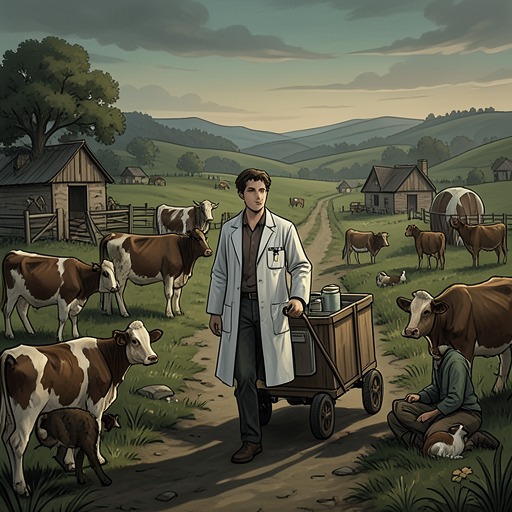
In the 1930s, horses remained part of everyday farm work, although tractors had already begun to signal their decline. In farms nearer the foot of the Dale, where arable land was more common, rows of stables were half empty. Yet enough horses remained that the spring castration season made May and June difficult for Herriot. He disliked the work and could face as many as a hundred cases, so its return cast a shadow over several successive springs. The seasonal repetition places veterinary work within an agricultural calendar: these were not rare emergencies but a demanding, recurrent part of practice.
The method itself was changing. For generations, a colt had been cast and secured, giving the operator complete restraint but making the procedure laborious. By the time Herriot qualified, standing castration was gaining favour: a twitch was applied to the upper lip, local anaesthetic was injected into each testicle, and the operation proceeded without casting. Herriot recognized the newer method as faster, but the large number of cases and the practical responsibility of performing them kept the work from becoming routine in any easy sense. One visit brought him to a loose box where the sounds from inside made clear that the animal was no small colt. The contrast between an efficient method and a powerful, unpredictable patient is part of the experience the season imposed.
Horses also belonged to a world that was not exclusively rural. In Glasgow, Herriot came upon a horse standing between the shafts of a coal cart outside the library below Queen’s Cross, surrounded by cars, buses, and hurried pedestrians. The animal seemed out of place amid the traffic, like a remnant of an older order, but its presence offered a chance to encounter an equine patient in the city. Set beside the thinning farm stables, the scene makes the horse’s changing position tangible: mechanisation was reshaping both the countryside and the streets, though it had not yet removed horses from either.
Diagnosis Under Pressure
The most severe horse cases expose how clinical conclusions are built from observation rather than recovered wholesale from a textbook. On an eight-mile journey to one call, Herriot mentally recited Caulton Reeks’ Common Colics of the Horse, a book he had studied so often that passages seemed to accompany him as he drove. At the destination, he found a bay horse in a large, deeply bedded box, repeatedly circling and visibly distressed. The scene made clear that this was not an ordinary bout of colic, and Herriot rejected the idea that a simple black draught would be enough.
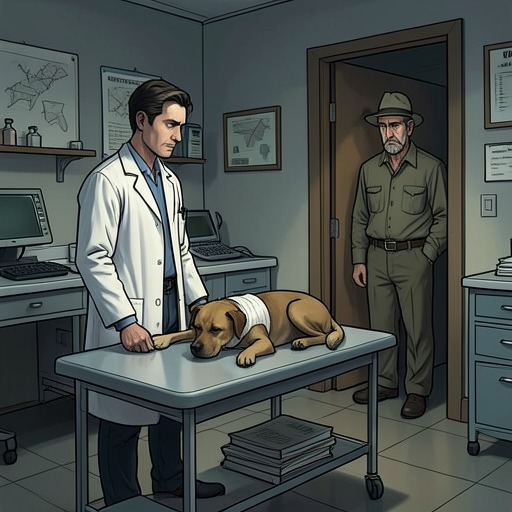
The examination turned the alarming first impression into a more specific diagnosis. After water was brought, Herriot lubricated his arm and examined the horse rectally. He felt that the small intestine had shifted to the left and found a tense, distended mass where it should not have been. From those findings he concluded that the horse had a torsion. The episode links the remembered textbook to tactile evidence gathered at the patient’s side: study supplied a framework, but examination made the diagnosis. It also shows that expertise in this work involved distinguishing a familiar label from a condition whose seriousness required a different response.
Other cases demanded recognition of a problem that could not be solved by a quick visual check. At Dixon’s, a Clydesdale mare strained without producing a foal, and no feet appeared. Herriot suspected a malpresentation. On examination, he found the foal’s tail and pelvis, with its hindquarters extending beyond his reach: the foal was coming breech. He understood why the position was especially difficult in a mare. Although a practitioner experienced with cows might manage a breech birth there, the foal’s much longer legs made the same problem more challenging in a horse. The case makes anatomical knowledge practical: the diagnosis identified the obstruction, while the difference between species determined the difficulty of dealing with it.
A suspected abscess behind a patient’s throat presented a different kind of uncertainty. Herriot considered that it might be inflammation, but was concerned that an abscess could form in an inaccessible place and, if it grew large, interfere with breathing. His limited experience included cases that had either remained small or ruptured spontaneously, so he had no guarantee that this one would follow a benign course. The account preserves the distinction between a possibility and a confirmed diagnosis, showing how a veterinarian must take a risk seriously even when the available evidence does not yet settle what will happen.
Procedures, Accidents, and Experience
A colt injured while trying to leave its paddock required more than observation. Bred from a fine hunter mare, he had attempted to jump a fence and was impaled on a post, causing extensive damage to the breast. The injury called for a general anaesthetic and repair. Herriot noticed that Siegfried Farnon seemed disappointed that the case was not more interesting, and wondered whether the request to take over was also a test of his work. Recalling an earlier operation in which he had been wasteful, he resolved to be more careful this time. The episode places technical work alongside professional self-scrutiny: the horse needed treatment, while Herriot was also learning how his judgment would be assessed.
A week later, another colt lay under chloroform while Herriot worked at the animal’s neck and administered more anaesthetic. The scene belongs to the same recurring account of procedures that required control, attention, and the management of a large patient. In the spring castration season, Herriot’s unease was not simply dislike of a task; the scale of the annual workload and the realities of carrying it out made the procedures a persistent test of competence.
The racehorse cases sharpen that test. Herriot admitted that his practical experience with racehorses was negligible. Siegfried Farnon, whose interest in horses meant that he usually took equine work himself, had handled much of the practice’s previous business in that field. When Herriot was faced with a beautiful three-year-old whose knee had been badly damaged in a fall on a ramp, he was conscious both of the seriousness of the case and of the possibility that the renowned specialist Brayley-Reynolds might scrutinize his work. The incident joins clinical responsibility to the pressure of professional reputation: the patient’s condition mattered in itself, but Herriot also felt the weight of being judged against the standards associated with a celebrated horse practitioner.
A more specialised opportunity arose for Siegfried at the North West Racing Circuit. The officials were considering him for a supervisory veterinary post covering meetings, work that would include suspected doping cases and would require specialist knowledge. General Ransom and a colleague were to assess him at the races. Siegfried was interested but questioned whether spending roughly three days each week at racecourses would be too much. During the visit, a horse that had slipped at the last bend remained down. The course veterinarian, Merryweather, examined its limbs and found no fracture, then identified a blow to the head as the likely problem. With help from people in the crowd, the horse was rolled onto its chest; after a short time it stood, swayed, and was led away. The episode shows why racecourse veterinary work demanded rapid assessment: an apparently grave fall did not necessarily mean a broken leg, and the examination changed what could be done for the horse.
Age, Care, and the Human Relationship
Not every equine call involved an acute emergency. Siegfried sent Herriot to John Skipton at Dennaby Close to examine two ageing horses that were losing condition and dropping partly chewed hay. The mare was about thirty and the gelding a year or two younger. She had produced fifteen foals and, apart from dental trouble, had rarely been ill; both horses had had their teeth rasped before. Their difficulty chewing gave Herriot a practical reason to attend to their teeth, while their long histories made the visit something more than a routine maintenance call.
Before Herriot approached, the two horses stood together in shallow water, rubbing their chins along each other’s backs. The quiet behaviour offers a glimpse of their relation to one another before the examination begins. Skipton’s account of the mare’s age, foals, and earlier dental care gives each animal an individual history rather than treating them as interchangeable farm stock. The present loss of condition, in turn, has a specific explanation to investigate: they were dropping incompletely chewed hay and struggling to manage their food.
Relations between veterinarians and horse owners could also complicate treatment. Mr. Sidlow’s farm lay outside the practice’s usual area, and Darrowby was the third veterinary firm he had tried. He had previously left Angus Grier of Brawton and then Wallace of Mansley, dissatisfied with both. His relationship with the Darrowby practice was already uncomfortable because Siegfried had offended him on the first visit. The case concerned a horse close to death; while describing the treatment he had attempted, Mr. Sidlow said he had pushed raw onions into the animal’s rectum. Siegfried answered with a deliberately pointed comparison involving Mr. Sidlow himself. The exchange reveals how an owner’s folk treatment and a veterinarian’s authority could collide, and how a sharp joke, even when directed at an implausible remedy, could leave a lasting mark on the working relationship.
The Pony at the Fire and the Meaning of Equine Practice
A visit to the Myatt family brought Herriot to a piebald pony among tethered horses beside a caravan. The family had gathered around a fire as snow fell, and Mr. Myatt came forward to welcome the veterinary help. The pony stood still while the others moved on their tethers. Its temperature was 104, its pulse rapid, and its hooves abnormally hot. Those findings, together with the pony’s distressed condition, indicated the seriousness of the problem and the pain associated with inflammation within the feet.
Siegfried Farnon treated the pony by opening a vein with a fleam. Blood flowed freely enough to alarm Mr. Myatt and attract the attention of the children, while Herriot wondered whether the pony could tolerate the loss. The procedure makes visible the uncertainty and tension that can accompany treatment, especially for onlookers unfamiliar with what is being done. About a week later, Herriot saw the family leaving Darrowby in their red caravan. The piebald was tethered at the rear; it remained a little stiff but was going well. Its return to the road provided a concrete outcome after the frightening visit: the pony had recovered sufficiently to travel with the family.
Taken together, these cases resist any single picture of the horse as either a symbol of vanished rural life or merely a clinical problem. Horses still pulled carts and worked farms, but their use was changing; they could be valued breeding animals, elderly companions, patients in urgent distress, or difficult subjects for a young veterinarian’s first serious procedures. Their care required knowledge, touch, judgement, and a willingness to revise an initial impression. The range of equine work also exposes the unevenness of experience: Herriot could be thoroughly prepared by reading and still encounter a torsion, a breech foal, or a racehorse injury whose demands exceeded what study alone could provide. The horses’ place in the narrative is therefore both practical and interpretive. Through them, veterinary life appears as a discipline of attention, conducted amid changing technology, imperfect experience, owner expectations, and outcomes that are never fully assured.